
The Purple of Life

She told me to hold on to the purple in my life.

My Photo
Name:
Location: Chicago, United States

I'm a 37-year-old editor and city dweller, wife and mother, moderately liberal and radically optimistic. I would fill my perfect day with a cup of coffee and the Op Ed section, a flea market and the playground, a run along Lake Michigan, a walk through the neighborhood with my son and my greyhound, a Cuban dinner and a bottle of red with my husband, and an evening flight to some European city. I wouldn't be picky about which one.

December 18, 2011

1961


John and I just returned from a three-day trip to Havana, a place we’ve both wanted to visit for a long time. It had been planned for a few months, although it was definitely eclipsed by our news of Will in November! This trip was fascinating, thought-provoking, and utterly unforgettable for me. I’m struggling to process it all. There are so many things I want to write about what we saw and experienced, what an isolated and passionate and crumbling and confusing country it is. How deeply I love it, and how much it makes me appreciate my own freedom. But if I could write only one story about those three days, this would be the one.

The Russian Lada was at least 30 years old, with red carpeting tacked over the dashboard and not a seatbelt to be seen. Before we got in, Alberto explained that after he’d been rear-ended, his mechanic was able to remove the back half of another Lada and attach it to the front half of his. Now the exhaust pipe was acting up and would need to be fixed. This didn’t surprise us, considering all the exhaust blanketing the air in Havana.

It was December 10, our second day in the city, the second of three total, and the only afternoon we had free during a busy schedule with our tour group. (Going with a specially licensed “people-to-people” tour was the only way the U.S. government would allow us to enter the country.) Alberto, our 66-year-old tour guide, a retired scientist and devoted revolutionary, had kindly offered to drive us to my mother’s childhood house if we paid for the gas. And so, clutching the maps she’d drawn for me and the old scanned photos I’d printed, I got in the front seat and John in the back, and off we rumbled, heading for a destination just a few miles away but 51 years back in time.

***

My mother is Cuban. She was born on the island, and she left it in 1961, at age 12, as part of the Operation Pedro Pan exodus. More than 14,000 children were sent out of the country by their parents to escape the communist revolution that had occurred in 1959 and was steadily encroaching on people’s freedoms. People with wealth were particularly affected, and my mother’s family fell into that category; my great-grandfather’s sugar-cane farm was appropriated by the government. Many children were sent to the USSR or the island’s rural interior for reeducation, no matter their parents’ wishes, and people suspected of being counter-revolutionary were spied upon and denounced. Thousands of people saw no choice but to flee, and with a few suitcases and some hidden money and jewelry, they left on planes to “vacation” in the States or Central America. They were never able to return. They left behind their friends, jobs, homes, possessions, pets, their entire lives. Most of them, including my family, had to rebuild those lives from scratch, depending on the generosity of the U.S. government, churches, and other exiles to gain a foothold in a new country.

By the mid-60s, every single person in my mother’s extended family had left the island except for one cousin. My oldest aunt left alone, then my mother left alone; she was told she was going on vacation in Miami, and when she arrived, the relative with whom she was staying told her the truth. The rest of the family was able to join them a few months later. I believe that only three of my relatives have ever returned to Cuba. I was the fourth.

***

Our goal that warm, cloudy Saturday was to find two houses situated next door to each other, one that had belonged to my mother’s family and the other to her grandparents, who were like second parents to her. The neighborhood had been green and gracious, with gardener-tended flowerbeds and gleaming, elegant homes. When we parked our car in the intersection near the houses, we found that now, like so much of Havana, the neighborhood is crumbling. There are weeds and broken sidewalks, rusted chain-link fences, houses with peeling paint and falling plaster. Some houses are in better repair than others, but the overall feel is one of shabbiness.

My mother’s house had been bright white and well-kept, with massive arches and a beautiful side yard and terrace. Now it’s gray and decrepit, only a shadow of its former self… it was a haunting thing to see. With Alberto as our translator, we knocked on the door and spoke with the old woman who lives there. She allowed us in, although she didn’t permit photos (John was able to take some clandestine video with his iPhone). Inside the house was dark, sparsely furnished, and melancholic, a giant cockroach dead in the corner. Even if we’d been able to take photos, I don’t think I could’ve showed them to my mother. The old woman explained that she’s unable to care for the building, and as we left, Alberto muttered that it will fall to the ground in 10 years if it isn’t repaired.

Cuba is a country of contradictions, and in a place where everyone is supposed to be economically equal, it’s surprising to see the disparities. My great-grandparents’ house is beautiful and well-preserved. It’s painted a tropical salmon pink, with the same colorful Spanish tiles in the porch floor that were there when my mother played jacks on them. The 30-something woman who lives there now rents rooms to visitors. She was a bit reserved at first, but she allowed us in to explore and take photos. She has a computer and polished antique furniture. Her husband is a carpenter. The rooms are painted bright colors; the crown molding is still intact. The floors are spotless black and white tile. Using the floor plan my mother had drawn me, we walked from room to room, and I was able to identify them all: my great-grandparents’ bedroom, my great-grandfather’s office, the stairs to the servants’ quarters. The house felt happy and loved. When we left, the owner agreed to pose for a photo with me. She smiled and rubbed my arm when I tearily thanked her for the gift of seeing the house and told her it was one of the best days of my life.

***

The first thing I did when I returned to Chicago was email the photos of the houses and the neighborhood to my mother. They were very difficult for her to look at, although seeing her grandparents’ well-cared-for home made her happy. Amazingly, she recognized the chandelier in the foyer and two pieces of furniture, a dresser and a dining-room hutch. They have remained in the house since my great-grandparents last locked the front door behind them in 1961.

All my life I have lived with the ghost of Cuba. But it’s a pale specter compared to the ghosts that haunt actual Cuban exiles who long so much for their island home. For me, Cuba has been a mythical, legendary place, the setting for countless tales of my mother’s childhood, her memories of her close-knit family, and also stories of struggle, danger, and desperation. When I look at the photos I took and imagine the past, I’m filled with a vast, palpable sadness for my family, the decisions they had to make and the great loss they endured. I’m also filled with pride at their courage.

I can’t ever know what it would feel like to close the door on a life and start over in a strange country with nothing, or to place my child on an airplane alone, not knowing when I would see him again. But now I know what it feels like to stand where my mother stood almost 51 years ago, suitcase in hand, waving goodbye to her dog and thinking excitedly of her “grownup vacation” to Miami to visit her aunt. I know where my grandmother pruned her rosebushes and where my great-grandparents sat on the porch after dinner. I know the park where my aunts and uncles played, and the pink house across the street where the boy who’d marry my aunt lived. I know the palm trees lining the streets. I stood on the same black-and-white tiled floors. I stood on the same floors.

Labels: , , ,

October 11, 2010

Italy: Nine snapshots of twelve days


One
The bar on the first floor of our B&B is tiny, with round tables for two outside, faded newspaper clippings of football stars on the walls inside. In the morning, we pay for coffee and a cornetto at the register, then go to the bar and place our order, two café lattes. Old men are drinking espresso and eating pastries, greeting friends loudly in Italian. In the afternoon, we look down from our window and see people sharing a drink and a chat, reading the newspaper. Way into the evening and beyond midnight, youngish, coolish (but not obnoxiously trendy) people are drinking beer and wine, smoking, debating, laughing. We join them, pay for our Peronis from the same man at the register, spill out with the Romans into the narrow cobblestoned piazza (the tables have long been taken), sidestepping passing scooters.

Two
Inside the Colosseum you can see below where the floor used to be, to the crumbling, grassy tunnels where animals and gladiators awaited their fate, listening to the roar and crash of the crowd above. Our tour guide, a young South African woman, explains that the Roman people so adored gladiators that when the winners bathed in olive oil after a fight, their attendants would carefully scrape the oil from their skin into bottles and sell them to an eager public. She tells us about matches between lions and crocodiles, shows us where the emperor used to sit. The dust of the Forum coats her turquoise leather ballet flats.

Three
In Pompei, dogs. For years, strays have roamed the ruins, and now there’s a movement for them to be adopted. A nonprofit group makes sure the dogs are fed and cared for while working to find them forever homes. We see several of these dogs wandering among the devastated houses and eerily empty lanes, snoozing in the sunlight against a 2,000-year-old wall.

Four
As we ride the tiny elevator up to our room in Positano, the hotel employee who’s bringing us there remarks that she has the same purse. H&M. We get off on the fifth floor, and she leads us down the hallway to a door at the end, #540. The room is dim and cool, with a coral and blue tiled floor. Curtained double doors lead out to the terrace we requested. She opens the doors and we step outside, and I literally gasp, become choked up, swallow back tears at the pure beauty of what’s before me. In the bright sunshine, the town of Positano tumbles down the cliff to the diamonded blue sea below, pink and white houses everywhere, green mountains, little boats so far below. I have never seen anything like it. John opens the bottle of limoncello.

Five
Hordes of older American tourists everywhere. Denim capris, Reeboks, baseball hats. They speak so loudly; we can’t get over how often we can hear every word. They talk about the price of a Burger King Whopper in euros. They cannot get over the fact that they have to pay (50 cents) to use a public bathroom. That the light wasn’t working in the bathroom. When they’re seated next to us in a restaurant and hear us talking, they say, “Oh good, Americans!” On the train to the airport, they ask a white South African couple “how [they] ended up down there” (they were, you know, born there) and ask if South Africa is “third world.” We’re never quite sure what our ratio of amusement to horror should be.

Six
There are dark clouds gathering over the medieval hill town of Montepulciano, but we park the car and begin to climb the steep streets anyway, looking for views and red wine. I tug on my black raincoat, grateful that I wedged it into my suitcase at the last minute. We approach an old church and see a young girl sitting on its steps with a man we assume is her grandfather. She has a small jet-black crow perched on her arm. I have to stop and look at this, the little girl in her school clothes with her pet crow. She feeds it pellets of food. The crow gulps them down, then attacks a faltering moth on the steps. I am still watching. She sees me, gestures me over, and asks “English?” “Si,” I say, “Do you speak it?” “Ehh,” she replies, shrugging. She motions for me to sit down and gently pushes my arm onto the stone step. “She’s showing you how to get the crow to come to you,” explains John. I rest my forearm on the step, and the crow nimbly climbs onto my arm and perches there, dainty claws gripping my jacket sleeve. I stare at it in wonder, and it stares back. The girl tells me that its name is Giulia.

Seven
Merely ordering a “latte” in the morning will earn you a glass of warm milk. The word “café” is key.

Eight
On our last night in Rome we wander down toward the Colosseum and take our chance on a restaurant that’s bustling with outdoor seating on a Tuesday night. The host explains in broken English that we’ll need to wait for 10 minutes for an outdoor table. He ushers us inside to the bar. Unfathomably, he brings us slices of warm garlic bread and two glasses of prosecco on the house, to enjoy while we wait. We are aghast. This little neighborhood place, which serves only appetizers and pasta, ends up being one of our best meals in Italy. As non-Italians we are in the minority. The 2006 reserve Chianti is so good we take a picture of the bottle. The foccacia bread is warm and studded with rosemary; my gnocchi has been baked in the oven. We sit and sip our wine, watching Romans walking home from work, gathering at the fountain near the restaurant. We eavesdrop without understanding.

Nine
Many times he walks ahead of me; I dawdle, staring up at the buildings, stopping to make a photograph. He is the keeper of the map and almost always knows where we’re going, except in Trastevere, where the ancient crooked streets would confound the most seasoned explorer. He wears a gray cargo jacket and expensive aviators that he drops twice on the cobblestones, no damage. He always suggests a drink after dinner. He’s interested in history, explains to me why medieval people lived in tower houses, why the windows were so narrow (so that armored knights couldn’t fit through them). He makes fun of the reverent way I say, “Mmm, wow,” after my first bite of something particularly delicious. He does not make fun of me when I’m too scared to climb the narrow bell tower in Siena. Sometimes we snipe at each other. Then we eat gelato (I introduce him to pistachio), and all is well. He is not gifted in languages, but he listens to Italian for Dummies podcasts and after a few days, he can pronounce “Dov'e il bagno?” with ease. He wants to see the Sistine Chapel. He drives the Fiat in Rome like he’s been doing it for years, in three-lane traffic where the lanes aren’t marked and scooters are weaving with abandon. After nine years of marriage and five trips to Europe, we still go together so well. I cannot imagine any other traveling companion.

Labels: , ,

October 19, 2006

It was Sunday night, our second day in Spain

Walking home from the gym in the early evening, I note that the air in Chicago, in October, feels so different from that in Barcelona… lighter and crisper, and certainly colder. And I wonder where he is right now, what he’s doing, if he kept my picture, if he ever even looked at it. The stranger who stole my bag right out of my hand.

It was around 10:30, 11 p.m., and John and I were in Barcelona, walking back to our hotel after dinner. It was Sunday night, our second day in Spain. It should have been our third, but our flight on Thursday had been cancelled because of mechanical problems (a thousand poxes on United, by the way). So we left a day late, lost a whole day of our vacation, and spent much more time at O’Hare than I want to remember.

The one consolation had been a six-hour layover at Schiphol Airport. We took the train into Amsterdam and spent a few gentle hours wandering around the Saturday-morning city: the quiet canals, a few bikes whirring past. Tall, narrow buildings leaning on their old foundations, shopkeepers sweeping the sidewalks, a few tourists snapping photos. The sky was blue, the morning light sifting through the trees lining the canals, us cradling our coffees and just wandering, wandering, on intuition and memory, no maps in hand. We’d stayed a few days in Amsterdam in 2004 and loved it, and this was such a gift, these unexpected few hours of strolling. We took photo after photo.

Anyway. Barcelona, Sunday night, 10:30, 11 p.m. We had enjoyed a great meal of tapas, split a bottle of Rioja, and I’d successfully communicated in Spanish with our bemused waiter. Now we were tired, satiated, and strolling back to our hotel, in a pleasant residential neighborhood just east of the Placa de Catalunya. We were about a block away. I was carrying a small purse under my arm, containing our camera, my driver’s license, my credit card, my debit card, a pocket translator, powder and lipgloss, and around 80 euro. (My passport was in the hotel safe.) It was still warm out, and I took the purse from under my shoulder to carry it in my hand, holding onto the straps. A few minutes later, we heard the roar of a moped, and a guy drove onto the sidewalk and snatched it away. It happened in an instant—one second I had my purse, the next I didn’t, and the guy was gone.

I have never felt such shock. I immediately began screaming “Thief! Thief!” and John took off sprinting, his sandals flying off his feet, yelling “Hey! HEY!” But of course there was nothing we could do; the moped was gone. It took me a few seconds to register the loss of the camera, and I think that’s what made me start crying. My camera. Our pictures. I stood in the street and sobbed. John came back and put his arms around me.

The whole thing was witnessed by a guy walking his dog (a greyhound—I tearfully explained to him that we had one, too), who seemed shocked that this had happened in his neighborhood. But I’d been warned to watch out for pickpocketing in Barcelona. After four trips to Europe and five years living in a big city, I truly didn’t think it could happen to me—I was aware, I didn’t dress like a tourist, I kept my bag on my lap when we ate in restaurants. If I’d been wearing a moneybelt, my cards and cash would’ve been safe, but the biggest, most upsetting and costly loss was our camera.

The two hours that followed are a dark blur to me now. We tried to find a police station that the greyhound owner said was nearby, but we couldn’t. We went back to the hotel to retrieve the piece of paper containing my credit card numbers and the 1-800 numbers to call; luckily I’d written them down just that morning. We attempted to use a public phone on the corner. We learned that you can’t make 1-800 calls from Spain. We went to a nearby Internet café to access my cards’ websites and find the right numbers. I called and cancelled my cards. We learned, to our great relief, that John’s debit card had a different number than mine, so we still had access to our bank accounts. Finally, around 1 a.m., we collapsed in our hotel room. I felt guilty, uncomprehending, in shock. John was angry at the thief. We lay down and turned on the TV for company, watched an old Spanish-dubbed episode of Knight Rider. It was the worst night of “sleep” I’ve ever had.

*****

Thankfully, the rest of our trip was trauma-free. The next morning we went to El Corte Ingles, Spain’s major department store, and bought a new camera. The saleswoman didn’t speak English, but we were able to muddle through. With the bad dollar/euro conversion, and the fact that we had to buy new batteries and a memory card, this was a pricey excursion. But it’s a nice camera.

Then we picked up our rental car and left Barcelona for the Costa Brava, the beautiful coast a few hours north: medieval villages, laid-back beach towns, the Mediterranean. Our base for three days in the region was an 800-year-old stone house in the quiet village of Peratallada. It was a good place to start putting the experience behind us, but it did take a few days. I often had flashbacks of the moment my purse left my hand, light as a feather. The sound of mopeds made my stomach tighten. It took me awhile to fall asleep at night. I knew John was thinking about it, too.

But as we saw more beautiful places, did more interesting things—hiked in the Pyrenees, immersed ourselves in beautiful, graceful, vibrant San Sebastian—the event fell further and further behind us. And now, almost three weeks later, it’s lost its bite; it’s a vacation story to tell. The financial cost of it still stings a bit, but I wasn’t injured. He didn’t get my passport. We had only two days worth of photos in the camera—what if it had happened at the end of the trip? (But oh, that morning in Amsterdam… it hurts to lose the evidence of that.)

My credit cards have been replaced, and I went downtown for my new license yesterday. Before that, every time I opened my wallet I was jolted anew to see the empty slot where my license used to be, where my own face used to look back at me. It made me think of some of the photos in my camera, the ones I took of myself in the hotel mirror, the ones John took of me… did he look at them? If he kept the camera, is he still? If he pawned it, does someone else have them now? It’s a strange thing to contemplate, and I haven’t quite stopped contemplating it yet.

Note: I’ve begun uploading some of my Spain photos to Flickr; it’s still a work in progress.

Labels: ,

September 27, 2006

The freshness of the wound

Perhaps it wasn’t the smartest idea to watch United 93 so soon before we fly to Europe. But that didn’t cross my mind when I saw it on the Blockbuster shelf last week. I remembered that John had wanted to see it, and that the New Yorker had given it a great review. So I rented it, along with The Squid and the Whale (an excellent movie, by the way).

We watched United 93 last night, and I truly can’t remember ever being as riveted by and entwined in a film. Which is amazing, considering the story is one we all know by heart. The traffic controllers who are shocked to see one of the World Trade Center buildings on fire that morning—brace yourselves, we want to tell them, you haven’t seen anything yet. The passengers on United Flight #93, as brave and resourceful as they are, aren’t going to triumph in the end—although of course, many more people may have died if that plane didn’t go down in a Pennsylvania field. I suppose that’s a sort of triumph.

I thought the film was masterfully done—subtly terrifying, plain and stark, no one actor really standing out, the people on the screen seeming so amazingly ordinary. That was part of the terror, for me—the ordinariness of the people on that flight. They were eminently recognizable. It almost felt like a documentary. I watched it with tears in my eyes and my hand over my mouth, my stomach actually hurting at times, feeling vaguely guilty, somehow—like a voyeur.

Five years have gone by so quickly. Five years ago John and I had been married for almost three months. We sat in our one-bedroom apartment in an old Victorian house in Grand Rapids and watched CNN for three days straight, eyes glued to the television, the skies eerily empty outside our windows. We kept waiting for people to be saved from the wreckage. At work, I visited the Cantor Fitzgerald website, scrolled down the names and photos of the dead. I cried. It seemed so big, the magnitude so difficult to understand. All those people. All those people.

Strange, then, last night, to be standing in my condo in Chicago holding a DVD case, reading the description of a movie dramatizing a piece of that day. How long and how short a five-year span can seem.

I’ve written before about how naïve I can be, how “glass-half-full” I am, how I could have written Anne Frank’s words: “Despite everything, I believe that people are really good at heart.” It always feels like a slap to the face when I’m reminded that this isn’t true. I found myself fascinated by the four hijackers in the film, especially the leader, a young man who looked Westernized, intelligent, soft-spoken, appealing. To sit in the waiting area, surrounded by unknown people he intended to kill. To sit on the plane, knowing what was about to happen. To threaten. To stab. All (or mostly) in the name of religion—religion, something I believe in, something I also hold dear. One of the most compelling moments in the film shows a passenger praying the Our Father, then cuts to this hijacker murmuring a prayer to Allah. Both calling on the God of Abraham, both equally sincere.

I’ve flown many times since September 2001—to New Hampshire and New York, to Philadelphia, Key West, Washington DC, the British Virgin Islands. Paris. And I will fly again, this time to Barcelona. Life has continued and will continue. I’m not sure that I really have a point to this journal entry; I just wanted to write about this. As one reviewer put it, “In the years since 9/11, much of what happened that day has become ingrained in our culture. We have absorbed it. United 93 picks the scab and brings back the freshness of the wound.”

Labels:

July 7, 2006

President Bush flies over my dinner table, and other updates

Last night I had dinner with my friend Mandy at Taste of Heaven, a charming little café and bakery in our neighborhood that has fresh, cheap sandwiches, leafy outdoor seating, and giant frosted cupcakes (as well as perfectly reasonable expectations for diners with children in tow that blew up all over the national news recently). We were sitting outside, enjoying our half-sandwiches and pasta salads, when our conversation was drowned out by the harsh blop-blopping of eight helicopters that appeared over the horizon and flew over us, heading west. “It’s the president!” Mandy said. “He’s here today in Chicago. I just saw it on the news.” Dubya? Here in Chicago, my beloved liberal bastion of liberalness? He doesn’t come here that often. But he graced us with his presence yesterday, buddying up with Mayor Daley and celebrating his sixtieth birthday downtown. And interrupting my dinner.

*****

So apparently I have a master’s degree in writing. A master’s degree! I graduated in June after four long years of classes—classes that I really did enjoy (well, mostly—we won’t speak of Classical Rhetoric here), taking only one a quarter instead of two so as not to give myself a stress-induced heart attack and become estranged from my family. It seems like a long time ago that I was 26, newly arrived in this city and mulling over the possibility of grad school. I wrote a journal entry about making that decision, but it was lost when Diary-X gave up the ghost. Suffice it to say, it was a big decision and one that I doubt I’ll ever regret. Jobs aren’t plentiful in the editing/publishing field, so anything that increases my marketability is a big plus.

It’s funny—people keep asking me, “Wow, so now that you’ve graduated, what are you going to do?” I mean, co-workers have asked me this. As if I’m going to retreat to some private island in the Florida Keys and get started on my great American novel. I usually reply, “Uh… keep working here?” I like my job; I’m not looking for anything else right now. Although it’s true, there is a sense of “What next?” after finishing something so monumental. (My mother’s answer to that question, it turns out, is “procreate.”)

It turns out that the first thing I did with my degree saved us $150. After returning from a weekend in Michigan last month, John and I parked for a few minutes in our alley to unload the car (our building doesn’t have a parking lot, and there was no street parking available). After one of our arm-laden trips up to our condo, we returned to find a cop writing us a ticket for $150 for blocking the alley. No horn honking, no warning, no mercy. I immediately contested it, composing a clear, straightforward, persuasive letter—even using bullet points to enumerate all the reasons that ticket was bullshit. And what do you know, it worked! The ticket was revoked. We celebrated by taking a neighbor out for her birthday and spending $165 on dinner.

*****

We’re heading out east for vacation soon, spending a few days in Manhattan and then a few in the Pocono Mountains. There we’ll stay with my parents, my sister, and her husband in the same cabin where my family vacationed every year until I was 18. That was the year we left Pennsylvania for Michigan, and I haven’t been back to the Poconos since.

I’m excited about this trip—the mix of city and mountains, the combination of tripping around NYC in heels and oversized sunglasses and hiking Bushkill Falls in cargo shorts and running shoes. Eating at the Shake Shack, fishing with my dad, exploring Central Park, breathing in the cool, clean mountain air… being transported back to all those late Augusts in the cabin: listening to Monkee records on my portable player and delving into a pile of Babysitter Club books; hoping, with my sister, to stumble upon a bear when we took our after-dinner walks with our parents; swimming in the cold blue lake up the road; always coming in third when the four of us played miniature golf… my heart kinda swells at the mere mention of all that. Manhattan will be fast-paced and dirty and eye-opening and glamorous; the Poconos will be a clean slice of simple pleasure with a generous side of nostalgia. I can’t wait.

Labels: ,

March 28, 2006

What I've been doing lately

I know, with such a scintillating entry title, you can barely tear your eyes away. But here's the list:

Looking at photos of sea otters. Sweet, fuzzy little sea otters. On Sunday I went to the Shedd Aquarium, because the day was stretching in front of me with nothing to fill it besides puttering around the condo and petting the dog. John was at the office, his second home during tax season, and suddenly I was overcome with a strong urge to see otters and penguins. So I took the el down to Roosevelt and walked the 10 minutes to the aquarium, where I was confronted with a looong line of families with squealing children, waiting for entry. Ugh—spring break! Luckily I’d brought our iPod along, so I passed the time listening to Sarah Harmer and Tom Petty and Sufjan Stevens, trying to imagine what it would be like to bring three children under the age of five on an aquarium outing. Answer: Damn hard.

After a 30-minute wait, I was finally inside and past the turnstile. I headed straight for the otter area and spent awhile watching the little guys swim, scratch their fur, and play with a plastic ball. I watched the penguins getting fed, and then I visited the stingrays, an assortment of eels, dolphins, various African fish, seahorses, poisonous frogs, and a hideous giant crab. I ended the day with another stop at the otter area. I really, really wish I could have my own otter.

Watching Big Love. Tuning in to this show is like watching a trainwreck. I simply cannot look away. After reading Under the Banner of Heaven, I’ve been fascinated by Mormons, and the fundamentalists are even more intriguing because they practice polygamy. The very idea of sharing John with another woman makes me want to throw a plate across the room. I just can’t comprehend how these women do it… to know that your spouse has an equally intimate relationship with someone else, that your spouse looks at someone else the same way he looks at you… it’s just mind-boggling, and such a radically different view of marriage. Thanks, HBO!

Hanging out with Moose. During tax season, I am Moose’s single parent, the one who feeds him dinner every night and takes him on most of his walks. Of course, this also means I have ample opportunities to meet the assorted odd people who live in, or simply pass through, our neighborhood. Some people don’t even seem to register my existence and instead speak directly to Moose. Two recent examples:

1. A shabby man leaning against a storefront and smoking a cigarette says to Moose, “Do you smoke?” Since Moose doesn’t actually know how to talk, I answer for him: “No, he’s not a smoker.” The man pauses, still looking at the dog. “Well, you do have a smoking jacket.” (He’s referring to Moose’s fleece coat—since greyhounds have next to no body fat and very short fur, they need protection in the winter.) I smile politely and move on.

2. An older woman sitting on the curb and wrapped in a sort of plaid cape asks Moose, “Do you like McDonald’s hamburgers? Because I sure do.” She is not eating a McDonald’s hamburger when she says this. I answer for Moose that yes, he likes meat very much, and she smiles at him in return.

Planning the summer. In true Chicago form, the weather is still cold, in the 40s. We’ll have spring for a month or so, and then we’ll be broiling. While I generally despise the heat and humidity, I’m looking forward to everything that goes along with summer—green trees, ice cream cones, baseball games, flip-flops, eating dinner outside. We have tickets to three Cubs games and reservations for two camping trips to Wisconsin. In July, we’re taking a trip out East to spend a few days in New York City with John’s brother and a few days in the Pocono Mountains with my family, in the big cabin where we used to vacation when I was little. It should be a good combination—just when the familial closeness of it all becomes a bit too stifling, we’ll be off to the Big Apple! I haven’t been to New York since I was 18, and that was just a daytrip to see “The Phantom of the Opera.” My brother-in-law lives in Queens, and I’m excited to explore his neighborhood, in addition to visiting Central Park and Greenwich Village and the World Trade Center site and various restaurants and bars. But the Poconos will be enjoyable, too, in its own way… hiking in the woods, clean blue mountain air, pine trees and simple homemade food… a time to sleep in and breathe deeply and reach back to remember my ten-year-old self. I very seldom get to visit the places of my childhood, so I intend to savor this.

Labels: ,

December 28, 2005

To be living in December of the year 2005

Originally posted to Diary-X

I want to write something that, years later, will make me remember what it felt like to be living in December of the year 2005, one month before my thirtieth birthday, in the city of Chicago with my husband and my dog. I am reading The
Year of Magical Thinking by Joan Didion. I am watching The Daily Show and Rome and Sopranos re-runs on television. I am listening to the new Coldplay CD and Sufjan Stevens and the Harry Connick Jr. Christmas album. I am eating Lean Cuisine lunches and yogurt and apples and chicken curry and my mom’s Christmas cookies.

I want to remember what it feels like to be sitting in my office facing the windows, the room glowing with lamps while outside is all gray and thick with clouds, the skyscrapers’ points hidden in the fog. To be wearing my favorite size-8 jeans and a gray and red button-up sweater, the gorgeous silver and marcasite earrings that John gave me for Christmas. The photos on my desk are of me and John on the Dingle Peninsula in Ireland; a group shot of our wedding party; Moose sitting tall and regal in the grass; my parents, me, and my sister smiling on the back deck; my college friends and I laughing on graduation day; and a
close-up of John on the beach at Cane Garden Bay in Tortola, in the British Virgin Islands, smiling into the sunset.

Sometimes I feel like I still have one foot planted in the sand on that beach. This makes sense when you consider that
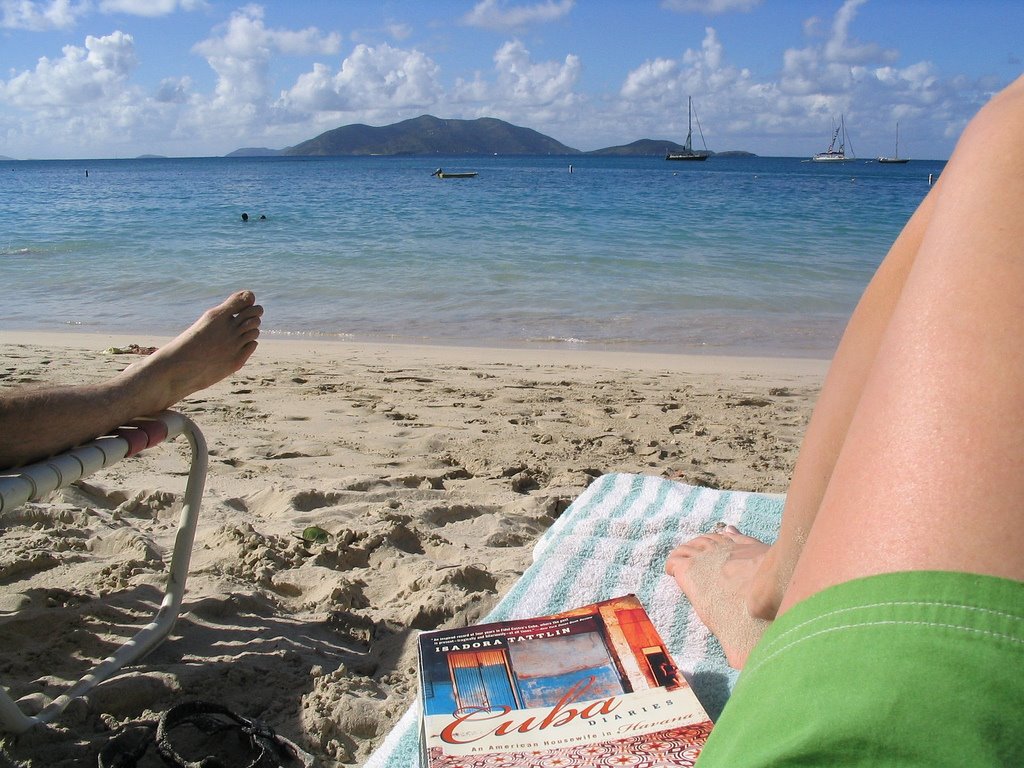
we were there just three weeks ago. I had never been really interested in the Caribbean… an island vacation seemed so cliché, somehow; I thought of people’s computer screensavers with palm trees on them, about frozen daiquiris and drunk, pasty middle-aged Americans in sun visors, and I shuddered a little. But John really wanted a warm, relaxing getaway before tax season starts, and we have a friend who goes often to Tortola. She’s very outdoorsy and adventurous and considers volunteering with orphans in Guatemala to be a fun vacation, so I respected her opinion. We decided to spend five nights in Tortola during the first week of December. And it was heaven, just heaven, and I firmly intend to return.

No high-rises, no chain stores, not too many tourists (and not all of them were Americans)… just blue-green bays and beaches and mountains and palms and sea-grape trees and sailboats and goats in the road and dogs running in the sand, and seafood roti and coconut rice,
painkillers and rum punch and Carib beer, and the two of us in a little apartment on Cane Garden Bay, eating homemade breakfast on the balcony and sleeping with the windows open at night, eschewing the air conditioner for the trade winds. I’ve never taken a trip like that, one so centered on relaxation—even the days we explored the island in a Jeep were slow-paced and stress-free. A trip that made it so easy to focus on my spouse and why I love him and how much I enjoy being with him, without e-mail and computers and laundry and dishes and meetings and dog-walking and, well, life getting in the way.

So I’m still remembering that trip quite vividly during these last days of 2005. I’m marking my one-year anniversary at a job that I love, and I’m keeping up with my freelance work, and I’m starting my second-to-last class in my master’s program. I’m volunteering at church and working out at a gym. I want to see “Brokeback Mountain” and “Munich.” I recently cried while watching “The Lion, the Witch, and the Wardrobe,” one of my favorite books of all time finally brought to the big screen.

*****


Sometimes I scroll back in this journal to 2002, 2003, and trying to determine how I’ve changed since then. I think my voice is different, but I can’t quite put my finger on how or why. I write less often than I did then, and I wish that wasn’t the case, but I can’t seem to discipline myself to change it.

Back in 2002 I was in awe of this city and the fact that I’d gotten here. I still feel lucky to live in Chicago. I still want to put down roots here, raise my family here, grow old with John here. I’m not as wide-eyed about the city as I once was, although I still find poetry in the oddest places. Last week I found it on my regular commute home. I was waiting for my Red Line train to arrive and vaguely wondering why the platform was so crowded. There was a definite buzz in the air… a few people were wearing Santa hats and clutching cameras…and then, what should pull into the station but the
CTA holiday train!

Every year, the Chicago Transit Authority decorates one of their el trains with colored lights and runs it on all the train routes according to a set schedule. The train pulls a flatcar that carries Santa, his sled, and his reindeer (Santa’s real, the reindeer are not). I’ve caught glimpses of it a few times before, running on the tracks between buildings, a blur of colored lights and Christmas music, but I’ve never seen it pull into a station. I have to admit that I was pretty excited to ride this train, so I boarded with all the other people and found a window seat.

The inside of the car was festive and glowing with white lights and silver garland, the poles wrapped up like candy canes, the usual advertisements for divorce lawyers and newspapers replaced with silly Christmas jokes and holiday pictures. Bing Crosby was crooning over the loudspeakers. “All aboard Santa’s train,” the conductor said, as we pulled out of the station. I looked around at my fellow riders: commuters with tubes of wrapping paper in their bags (that included me), parents holding the hands of young children, a few shabby, bundled-up elderly people, a group of excitedly loud African-American teenage girls, a few Hispanic gangster-looking guys (baggy pants, tough expressions), a tall blind man with a cane. It was the usual cross-section of Chicago public transit riders, but the difference was that every person on that car was smiling, looking around happily and making cheerful eye contact with other riders. This is not my usual experience on the el, where sullen expressions and middle-distance staring are the norm.

Each time we pulled into a station, the conductor announced, “This is the CTA holiday train, all aboard!” And at each station, the eyes of people waiting on the platform lit up when we arrived and a smile came to their faces, no matter who they were or what they looked like. I just could not get over those smiles, the excitement of all those jaded city people boarding the train. Bing Crosby gave way to jazz Christmas carols, and then gospel. A CTA employee dressed like an elf entered our car and moved slowly down the aisle, giving out candy canes. And I don’t know why, but suddenly I was fighting back tears at the sheer urban beauty of it all, this unexpected gift that pulled up on the track in front of me during an ordinary commute home. This motley crew of Chicagoans all smiling at each other and eagerly accepting candy canes from a transit worker wearing a ridiculous pointed green hat.


In December 2005, I was a person who could be brought to tears by the CTA holiday train. I’m glad to be that person.

Labels: ,

July 28, 2005

Eleven years

Originally posted to Diary-X

The woman who answered the door did not look thrilled to see me. “Can I help you?” she asked in a detached, semi-suspicious tone.

“Hi, yes, my name is Amy _______, and you bought this house from my parents in 1994,” I said, with my best, brightest, not-a-stalker-or-Mormon-missionary smile.

Her face changed; she smiled, looked at me and John and opened the door a little wider. “I remember you! You’re the older daughter, right? With the pink bedroom?”

“Yup, that’s me.” I explained that this was the first time I’d returned home to Pennsylvania since my parents moved to Michigan, and would she mind if my husband and I walked around in the backyard a little?

“Of course not! And why don’t you come in? You can look around inside, too.”

It hadn’t occurred to me that I might be able to go inside, to walk around the house where I lived the first eighteen years of my life. Now, a month later, those few moments I spent looking at the living room, walking up the stairs, standing in the middle of my old bedroom—they seem like a blur. My heart was beating faster than usual, and my voice sounded husky and wrong, and tears were gathering behind my eyes during those five, maybe six minutes. The woman got her toddler son up from his nap—his room is my sister’s old room, their grade-school daughter has mine—and carried him on her hip as she walked around with us.

They’d pulled up the carpets and refinished the wood floors beneath—very nice. The wallpaper border with the marching white geese still encircled the little kitchen. My mom had loved those geese, bought a goose-shaped spoon-rest and napkins to match. The furniture in their living room looked old. There were baby toys strewn around. My room was painted a cheerful yellow. I stood in that room, looked out the window at the view of the ranch house across the street, the lawn where we’d sledded and built snow forts, the cul-de-sac where I’d watch for Josh’s car. The view that I’d looked at every day for eighteen years. Even after eleven years, it had not changed.

“You know, we didn’t have the heart to paint over the message you left in your closet,” the woman told me. John looked over at me with a Huh? expression on his face.

“Oh my gosh, I’d forgotten about that,” I said, breathless, so overloaded and overwhelmed I could barely process it all.

“Take a look, it’s still there,” she continued, sliding open her daughter’s closet, that same white wooden door that I’d plastered with ads torn out of Sixteen and Teen Beat—Corey Haim, Kate Moss, Eternity perfume. And I got down on my knees and peered under the wooden shelf where I’d kept my shoes, and there it was… my eighteen-year-old penciled handwriting, declaring my love for this house, my sorrow at leaving behind the only life I’d ever known, the pain of moving twelve hours away from my “first true love,” Josh. It was dated July 5, 1994. I remembered lying on my back on the pink-carpeted floor, halfway in the closet, writing it. I remembered how it felt to leave this house.

A few minutes later, after I thanked the woman profusely, John and I walked through the backyard. I showed him the hedges that my father had planted, now sadly overgrown. Where he’d hung the homemade swing that my sister and I would spin each other in. The huge forsythia bush that we made our “shrub club”—no boys allowed! Where our dog Bessy was buried. My favorite hiding spots, the outdoor nooks and crannies that seemed so wild and magical to an eight-year-old. Where my parents always posed us for Easter Sunday photos. Under the apple tree, where I sat on a bee when I was four. The fish pond that my dad had built, with a waterfall and real lily pads and beautiful big stones—still there. I saw the goldfish circling lazily around and around in the brackish water. It was all still there.

Labels: , ,

May 6, 2005

Musings on unrelated topics that conclude on a rather sad note

Originally posted to Diary-X

Comments made by passersby during recent walks with Moose:

Dodgy guy loitering at street corner: Looks like you abuse your dog.
Me: ...uh...

Teenage couple walking toward us.
Girl to boy: Eww, look at that nasty dog! It looks like a big black horse! Nasty.
Me, silently: Bitch.

Little boy chasing a soccer ball into our path: Hey, what kind of dog is that?
Me: He’s a greyhound. He used to be a racing dog.
Boy: How old is he?
Me: He’s seven.
Boy, with look of pure wonder on his face: Wow! I’m seven, too! Wow.

*****

Tomorrow John and I are going to a Cubs game, which I’m pretty excited about. I’m no die-hard sportsfan, but there’s something about Wrigley Field that captivates even an unathletic bookworm such as myself… the organ music, the ivy, the lack of glowing billboards and stupid mascot antics and electronic advertisements. It just feels simple and American and authentic. Also, there’s cold Old Style and warm soft pretzels.

During our first summer in Chicago, John and I went to four or five Cubs games. (Tickets were easier to get then, before the Cubbies almost made it to the World Series.) I’ll never forget what I wore to my first game: shorts, flip-flops, and a short-sleeved shirt. I was utterly shocked at how many of the twenty-something women of Chicago’s North Side dress to attend a baseball game: skimpy sundresses, heeled shoes, outfits I’d wear out on a Saturday night. Amusing, actually. Maybe it’s my marital status talking here, but tomorrow I’ll be decked out in jeans, a long-sleeved shirt, a pair of Roos, and a hooded sweatshirt in case it’s chilly. Ladies. It’s a baseball game. Must we strive to look sexy all of the damn time?

*****

A few nights ago, while hamstering along on the treadmill, I watched a disturbing documentary on the liberation of concentration camps after WWII, called “Memory of the Camps.” (And no, the irony did not escape me—running in place in a quest for fitness and slimness while watching horrifyingly emaciated people try to digest a bowl of soup.) I ended up working out an extra 20 minutes in order to watch the end of the documentary, which is basically just footage shot by the liberators along with a sparse script written in 1945. I highly recommend watching this program. I’ve seen a lot of films and read a lot about the Holocaust, but I’ve never seen footage like this. It is, simply, unbelievable.

When I was studying in Vienna at the end of college, our group took a field trip (if you can call it that; the term seems too cheerful, somehow) to Mauthausen, one of the smaller concentration camps located in Austria. The prisoners were worked to death hauling stone out of a quarry, or they were starved, shot, gassed, or frozen to death. Jews, Russians, Gypsies, Catholic priests, and gay men were exterminated there, among others.

It was a life-jolting experience to visit this place. I remember being utterly silent during the entire three hours we spent there, and not taking photos of the gas chambers because it somehow felt disrespectful. The weather was mild and sunny, and the Austrian countryside spread out green and placid around us. There were actually some houses and farms overlooking the camp complex. I can’t imagine living so close to such a tangible reminder of human depravity.

En route to the camp, our busload of college students stopped to eat at a little Austrian restaurant, and some people bitched and complained that they couldn’t understand the menu, that none of the food appealed to them, etc. A few hours later, standing at the bottom of that rock quarry where so many men met their death in the freezing Austrian winters, I was struck hard with shame. (Soon after I returned from Vienna, I wrote about this experience for an essay contest. I won $50.)

Labels: , , ,

February 25, 2003

A big green backpack and a vague set of directions

Originally posted to Diary-X on February 25, 2003

My back has been itching for a pack lately. I probably shouldn’t be subscribing to National Geographic Traveler. This month’s issue features Paris, a place I was never particularly interested in visiting…until now, of course. I read the article on finding the hidden parts of the city, and looked at the photographs of street markets and little public squares and people drinking coffee on their way to work, walking down the old stone streets, and I could almost smell the place. It’s amazing how Anywhere But Here can seem so inviting, simply because it isn’t Here.

Of course, it doesn’t help when people like my oh-so-well-traveled friend Chris send me conniving little emails like this:

i can only say that you two should forget about going back to europe and check out south-east asia. everyone looks at the ticket prices and distance and thinks that it will be too expensive, but i say to you... it might change your life. thailand is one of the easiest places you might ever travel to with beaches, incredible nature, and ancient temples; laos, which is changing quickly, is the most beautiful country i have ever visited (and i have been to ireland); vietnam was easy and amazing; and malaysia which has the most incredible wildlife i've ever seen. each of these countries was easy to travel in, amazingly cheap and clean accommodation, food to tantalize each and every taste bud, and people that will make you laugh and truly believe in human goodness. most days you can eat, sleep, travel, and see amazing things at about the same price as a youth hostel in europe. think about that. just something to think and dream about.

~~~~~

My family didn’t travel too ambitiously when I was young. Every year, we spent a week on the Jersey shore and a week in the Pocono Mountains. (There was a trip to California and a Disney World pilgrimage, but they were the exceptions.) When the hypodermic needles starting washing up on the shore in Wildwood, we moved our beach holidays to Ocean City, Maryland, and Nag’s Head, North Carolina. But we never went to New England, to New York State, to the Deep South, to Arizona or Colorado. We didn’t visit Civil War battlegrounds or big East Coast cities. We had fun on our vacations; they were relaxing, but they were also, for the most part, predictable.

I can’t remember a time when I wasn’t obsessed with going to Europe. Spending three weeks in Vienna through a college program was probably one of the best gifts my parents ever gave me (they paid for most of it). I took a class in modern Austrian history, explored the city pretty thoroughly, and spent my weekends in Salzburg and Prague. The group of 80 students could be irritating at times—there were the usual ugly Americans, drama queens, and sloppy binge drinkers—but there wasn’t a day that I wasn’t grateful to be there. After three weeks, Vienna felt ever so slightly like a home. If I were to show up there tomorrow, I would, in a basic sense, know my way around.

~~~~~

I didn’t do the true backpacking thing until the following year, 1999. I used my Christmas bonus money to spend two weeks in Italy. My father recommended putting that $1,000 toward my college loans, but my mother said, “Take this chance, now, while you have it.” So I did.

At first, I planned to go to Italy and Greece with my high school boyfriend. We’d remained on good terms since we broke up in college, and we decided to travel together… until three months before we were supposed to leave, when he met a girl, and the girl didn’t like the idea of him gallivanting around Europe with his ex. (I scoffed then, but now I can understand.) He bailed.

I often wonder at how fate works, because there was a chance that maybe, just maybe, we would’ve rekindled something on that trip. We both knew that was a possibility. I was single, a bit lonely, and open to reconnection, especially if that reconnection took place while riding a double-seated scooter along an oceanside cliff in Greece. But obviously that wasn’t meant to be, and I decided to go alone and stick to Italy. And three weeks before I left, I had my first date with John.

I’ll never forget the feeling of stepping off the plane in Rome, walking into the airport, and realizing there was no one there to meet me. No one in that whole city knew I was there. I had a big green backpack and a vague set of directions to the hostel I’d booked, and that was all. There were guards with machine guns standing nearby, and I didn’t speak the language, and the big group of middle-aged American tourists was heading off in the opposite direction, to their chartered bus. I wanted to be purely excited to be there, but I also wanted to get on the chartered bus. My excitement was mixed with fear and a healthy dose of "What the fuck have I done??"

One thing I learned in Italy (besides how to read a map really, really well) is that traveling is easily romanticized, both while you’re planning for it and when you’re recounting your experiences afterward. When describing my two days in the hill town of Assisi, one of my favorite places in Italy, I can talk about the hour I spent perched on a garden wall outside a convent, writing in my journal, with the patchworked green countryside of Umbria spread all around me. I can write about the holiness and hush of the Basilica of St. Francis, and my solo dinner of margherita pizza and red wine in the town square, as the sun set and glistened on the medieval stone walls. I can describe the walk through silent vineyards back to my hostel, and the grocery dinner of bread, tomatoes, cheese, and Peroni beers that I shared with some Australian guys in the hostel, sitting on a wooden deck overlooking a thick expanse of trees. (One of the guys, Tim, had stamps from 89 countries in his passport and had recently been to Cuba. I frothed with jealousy.)

But those poetic descriptions don’t take into account how hard it was to figure out which train to take to Assisi (I spent about 30 panicked minutes thinking I was heading in the opposite direction). They don’t include the afternoon that I took “off,” tired of site-seeing but feeling vaguely guilty about spending three hours reading The Great Gatsby on the steps of a temple. (I did some excellent people-watching that way, though.) When I got home, I never really talked about how nervous those two guys from Australia made me, and how I slept with a whistle around my neck in that hostel, and how I had a nightmare and woke up thinking I was sleeping on a park bench and had utterly no idea where I was. Then there was that painful sunburn on my shoulders, and the sense of never feeling quite clean after a hostel shower…There were times in Italy when I longed for my bed and my car and my food and my language. But when I got home, I longed for my backpack.

I returned to Europe in the fall of 2000 with John. We spent two weeks in Ireland. We were planning our wedding and probably should’ve saved our money for that, but, well, we didn’t. (As John likes to say, “Money always comes back.” He’s an accountant, so I trust him.) The feel of this trip was different—no real language barrier, and we rented a car. But there was still that sense of discovery: every single thing that we saw, every day, was new to us. And there was that stretchy sense of time: two big empty weeks, when it didn’t matter if it was Sunday or Thursday, and we could do whatever we wanted and go wherever we wanted within the boundaries of Sept. 2 and Sept. 16. We could’ve taken the ferry to England or hopped over to Scotland. In Italy, at the Rome train station, I could’ve just as easily boarded a train for Switzerland or Spain. It didn’t matter; I just had to be back at the airport when my plane left. And I think that’s one of the most alluring things about traveling—that sense of freedom that you can never have at home, in your real life.

~~~~~

Now that I’m a tiny bit older, I understand that I’d like to buy a house someday, and I’ve committed myself to the expense of grad school. The money in our savings account isn’t being hoarded solely for overseas travel…but I still dust off Mark Twain’s quote, which I took with me to Italy, every once in awhile: “Twenty years from now, you will be more disappointed by the things you didn't do than by the ones you did do.”

Labels: ,